Friday, February 28, 2014

Following the wrong money

I'm pretty proud of the little Twitter bot I wrote to auto-tweet large Illinois campaign contributions, but this morning I realized its true insignificance. Campaign finance is simply not where the story about money and politics really is, and all of the sound and fury over its minutiae signify nothing. In 2012, estimates vary but about $2.6 billion was spent on the Presidential race; around $6 billion was spent on all federal races (including House and Senate elections).

In 2014, the White House budget projects spending $3.78 trillion dollars. In other words, the most expensive set of elections in American history - by far - accounts for about 0.16% of the federal budget for 2014. The government will spend the equivalent of one of the most expensive Presidential races America has ever seen in 4.5 hours. As a percentage of the federal budget, the 2012 Presidential election cost less than the percentage of health care spending we allot to circumcision.

The question isn't, "Why is there so much money in American politics?" but rather, "Why is there so little?" And more importantly, "Where is the real money going, and where's the real quid-pro-quo?"

Those are tough questions to answer, so I won't. A lot of people are already working on them, and entire careers can be devoted to understanding where the federal dollar is spent. What's interesting to me is why campaign finance data gets so much more attention in journalismland.

I started wondering about this this morning at an overflowing NICAR panel on mining FEC data - one of about 4 explicitly devoted to campaign finance, with another half-dozen panels using campaign finance as one topic among others under discussion. Legions of nonprofits and open-source projects and websites are devoted to analyzing and dissecting campaign finance - FollowTheMoney.org, the Sunlight Foundation's Influence Explorer, OpenSecrets.org, and pretty much every major and minor newspaper has some sort of campaign finance project.

There's nothing wrong with all this activity, to an extent - great, valuable, important stories remain to be found in campaign finance data, at both the state and federal level. But I think the real reasons for this surfeit of attention paid to such a tiny chunk of money are structural, and troubling.

For one thing, it's just easier to analyze and write stories about this data. Disclosure laws are admirably firm(ish), so there's a ready source of easily-understood data about who's giving money to campaigns and who's getting money from them. Dates, contribution amounts, names, addresses, occupations - it's all there, it's all obvious and straightforward, and your only headaches are in parsing file formats and matching up misspelled names.

It's also much easier to make an assertion on the basis of this evidence alone. Did someone give $20,000 to a politician who then appointed them to an office? That's all you need to know in order to raise an eyebrow, and it's all public record, so it's totally defensible. Was a contract awarded to someone's brother, when another firm was better-equipped to do the job? That's vastly harder to prove, and a lot of that evidence isn't already public, requiring even more effort.

Ultimately, my fear is that campaign finance has had a spotlight trained on it for so long that the real malfeasance has migrated. If you're a shady character looking to exert undue influence on a system, or looking to profit from that system, are you going to commit your shady acts in the one place you know reporters are constantly looking for stories? The one place you know everything will be made public, scrutinized by bots and concerned citizens and hungry journalists looking to find you? Or are you going to start sleazing around the government contracts that are so much larger, and so much more opaque, and already so sleazy to begin with?

In short, if you're trying to exert undue influence or scrape some cash off the top of a fat government contract, are you going to go where the sunlight is, or where the money is?

Sunday, February 16, 2014

Midnight in the Mayor Bilandic Memorial Dibs Garden


It's the only memorial to Mike Bilandic I've ever seen, a festive celebration of two great Chicago traditions that nobody outside the city really understands, while those inside it only pretend to: Chicago celebrates its political corruption with a zeal normally reserved for the defense of parking spaces, and now some great genius has twinned the two.

In a side alley near 53rd and Woodlawn - those of you who know the city know instinctively where this is, another grand City tradition, marking territory and therefore the teller of a tale by implicit association with intersections - the memory of Chicago's snowed-in hopeless seat-warmer lives on, eternal flame tended by irony and nostalgia in unequal measure.

He let us drown in snow, the elders tell us, reminding us of a day when the provision (or lack thereof) of city services would drive even a Machine Mayor from office. Woe betide the public official who fails to salt the streets, a lesson burned into the memory of anyone who wants to see their name in Chicago's version of flashing lights, on thin cardboard placed just outside the statutorily-mandated 100 feet from a polling place.

The machine gave us Bilandic, just like it gave us Daley before him and Daley after him and on down through the generations, past Cermak and Kelly and Nash and Brennan - dig those first-generation names that adorn our street signs still - all the way back to Ogden. But the machine, back when it was the Machine, gave us Bilandic right out of the fingertips of Chicago's real first Black Mayor, Wilson Frost - now there's a name you don't see on street signs - when it decided that the city charter didn't really mean it when it said that the (black) President Pro Temp of the City Council became Mayor when the Mayor died.

So they locked him out of the office, because of course they did, "can't find the keys," they actually told poor Wilson. One of those conversations in which you imagine everyone knows what's really going on whether or not anybody says it out loud, speaking in a code so transparent it might as well not be a code at all but appearances, even in Chicago, must be kept.

So yeah, Acting Mayor Frost tried to park in that space. It was clear of snow, no obstacles in sight, but the rusted-out chair was merely invisible. Don't you know it, Bilandic had shoveled that space out this morning and it was really his after all. He just forgot to put the chair out, but it was there, don't you worry about that. They should have called him Mayor Dibs; I hope they did.

The snow did him in. That's the legend, anyway; I wasn't around, or born. He didn't get Snow Command out on the roads fast enough, I guess, though I'm not sure what he could have done. January 14th, 1979, left Chicago buried under a still-record 29 inches of snow. This has definitely been a historically brutal winter, but we've only seen 62.9" of snow so far; in 1978-79, they got 80.6", which remains the snowiest winter since records were kept in this city.

The other thing that happened in these early February weeks 35 years ago was, as Mayor Dibs' luck would have it, a mayoral primary, and grumpy Chicagoans expressed their displeasure by voting for Jane Byrne. She ran as a reformer but she was solidly of Machine stock. Byrne was appointed to Daley's cabinet and fired from Bilandic's, and would, as Mayor, replace the head of the most important Machine institution, the Cook County Democratic Party, with a guy nicknamed Fast Eddie who somehow managed to be an even sleazier character than you might expect. At one point, ostensibly to curb the violence in the neighborhood, she moved into the (now largely demolished) Cabrini-Green projects, planning to stay for "as long as it takes," according to her press secretary. She stayed for three weeks.

Saturday, September 7, 2013

A night in Chicago

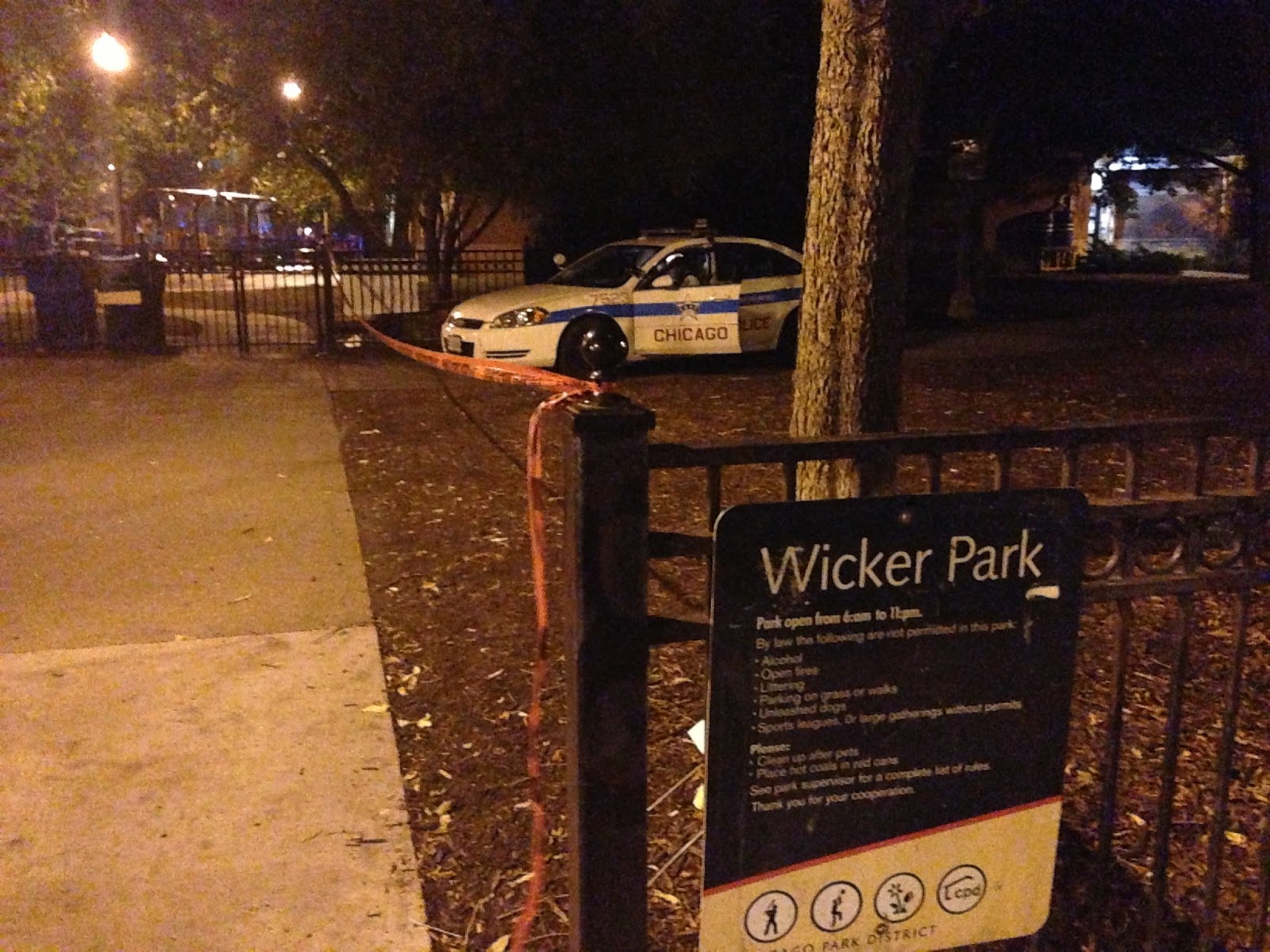
In Wicker Park on this Friday night, lights flashed against the fieldhouse as police cars sat parked in unfamiliar positions, guarding the scene of a double shooting as a house party raged on and pockets of stylish young people walked past, bemused and intrigued. At one point, a Chief Keef song blasted out of the house party's speakers in what seemed like an ironic commentary on the rarity of the shooting that had taken place across the street - unless, as is equally possible, they had no idea anything bad had happened outside the flashing colored lights and sweaty gyrating youth ensconced in their hip, rich enclave.

Shootings happen in Wicker Park, just like they do all over Chicago, but they're different there - much less frequent, more unusual spectacle than depressing daily occurrence. Gangs fight in the park from time to time, but in Wicker Park it seems more like the exception than something common enough to warn your kids about. And the reaction of passers-by to the scene we saw tonight was emblematic of that difference: some gawking, some nervous laughter, some curiosity. But nothing like the tired anger in one woman's voice in Woodlawn, as she loudly railed against the police for just standing around, seeming to do nothing but draw paychecks and shoot the breeze.

She was angry for a lot of reasons, not least of which being that - unlike in Wicker Park - the shooter this time was a police officer. Justified or not, it's not for me to say, but she saw it as part of a pattern: "They're always shooting black people," she said, or something to that effect. She was mad at the police, for being ineffective, for being violent, for treating her neighborhood differently than they treated rich white neighborhoods.

The cops probably do treat her neighborhood very differently. At another scene on the West Side, a carful of police rolled past us and called out - seemingly to us, the only people in the vicinity and certainly the only white civilians - "Another day with the savages!" They don't say shit like that on the North Side, because they don't think like that about the populations they're policing.

But the cops aren't the only ones who change their attitudes when they cross certain borders. I felt pretty ridiculous wearing a bulletproof vest in Wicker Park, a neighborhood I've hung out in hundreds of times with no armor, but I was glad to have the vest on the West Side. Nothing really happened - a bit of a public brawl, mostly verbal, in front of dozens of heavily-armed officers following a shooting - but the scene felt different and I felt different. The surprised curiosity of Wicker Park had given way, just a short trip down Western, to tension and provocation. Throngs of teenagers yelled and massed and stared each other down and scattered and regrouped, on the periphery of the police presence. For their part, the cops let them be, at one point encouraging them jokingly to take their fight across the street, where it would be in another district and another sergeant's problem.

I was spending the night riding along with Pete Nickeas, the Tribune's overnight crime reporter, as he headed from scene to scene, gathering details and color to run down the night's mayhem and tell some personal stories where he could. He's been doing it for long enough to know more than the cops do about their own crime scenes, at least sometimes - pointing out a flat tire on a squad car that nobody, including the officer sitting in the car, had noticed; filling an arriving sergeant in on what had happened and how things were going elsewhere in the district; even waking up the FOP representative after an officer-involved shooting, apparently before anyone else whose actual responsibility that was had gotten around to it.

We saw a side of Chicago that is at once nationally-known and yet largely invisible to many residents of this city, particularly those who don't live in certain neighborhoods or stay up late. To focus on shootings is to miss the point, probably - the statistics tell the tale, crime is down. And yet. "Crime is down," joked the FOP rep once the cameras stopped rolling and all the nighthawks started filling each other in on stories, incidents, tragedies missed over the scanners while photographing another scene. "Crime is down...so they tell me, anyway."

Wednesday, July 24, 2013

Capturing a morning

This morning was one of the most spectacular I can remember in a long time, for no other reason than the temperature and the clarity of the air and sky were at some perfect harmonious synchronicity with each other. Like the strings on a viola that vibrate, at a certain frequency and only at that frequency - not a hair too high or too low, or the effect is ruined - in such a way as to sound utterly perfect, resonating with the wood and the air and the other strings and stroking the aural cortex of our brains so effortlessly and harmoniously that the sound is Angelic.

The temperature was in the upper 60s, after a long hot spell, and something about everything felt like fall, but not just fall - fall pregnant with possibility, fall promising a future, the fall of a decade ago for me - getting on a bus to go to class in college, going to work on a campaign, going off to build something I didn't know the future of yet.

The crisp air and the sun made me remember how fantastic it is to be alive.

Wednesday, July 3, 2013

RIP, Douglas Engelbart

Watch this video of the aptly-named Mother of All Demos and see how clearly Doug Engelbart saw the future coming, and then went out and built it for us:


Sunday, March 17, 2013

Winning isn't everything

Maybe Rick Reilly's right that the Cubs haven't won a World Series in over a century because Wrigley Field is so great. He's almost certainly wrong about that, but let's grant him the point. Does that mean the Cubs should allow billboards along the outer walls of the stadium, blocking the view from nearby rooftops?

Hell the fuck no, Rick. That's a terrible idea. I'm a fair-weather Cubs fan, I'll admit, but I'd like to see them win a Series in my lifetime. But I don't give a damn about the profit margins the Ricketts family gets from owning the Cubs (and if my current employer, the Tribune, still owned them, I still wouldn't care), and I don't think being a Cubs fan obligates me to. And as a resident of the city of Chicago, I care a great deal about the beauty and, yes, horror of horrors, tradition of Wrigley.

Look, it's a beautiful stadium and a great place to see a game, and the city north side entire benefits from that to some degree. It's not like I care about the rooftop owners either, but more billboards around the stadium - or anywhere else in the city - is hardly a desirable outcome.

I'm sure the facilities could be upgraded, and that would be a worthwhile improvement. By all means, build a better clubhouse and weight room and all the rest, as Reilly recommends. But let the improvements stop at the invisible stuff that the players need and maybe makes the fan experience better - we don't need more ads anywhere, let alone in one of the last great public spaces in America uncluttered with advertising.

The Ricketts family didn't buy any random baseball team with a generic corporately-named stadium. They knew what they were buying when they bought it, and they're extremely wealthy in spite of all the minor inconveniences leveled upon them by owning one of the greatest franchises in American sports. They can afford to pay players enough to win a World Series without making Wrigley just like every other ballpark in the country, so they should do it, and if they wanted a better deal on a stadium with no soul they should have bought the Sox.

Friday, February 22, 2013

Reggie Rose is right, kinda

Having watched the Bulls get destroyed by the Heat last night, it's not hard to understand where Reggie Rose is coming from: even with a healthy Derrick Rose in the lineup, these Bulls don't really seem like they can beat the Heat, and that won't change until Bulls management adds a couple more pieces, or one legitimate all-star, to the roster.

It's not surprising, but it's still gratifying, to see some fire in the bellies of those closest to Chicago's most beloved athlete: Derrick Rose's window of greatness, like all superstars, is finite and closing, and wasting even a single season is tempting fate. So you want Derrick's older brother and manager to be itching for him to play, surrounded by the best lineup money can buy.

But you've also got to look at the big picture, in order to understand how that lineup can possibly come together. And for that, there are two key pieces of data to observe: first, that Derrick Rose - his game, his story, his personality, everything about him - is a once-in-a-generation Chicagoan. Somebody like him may never come again to this city or this league, and that means that as important as it is to have a sense of urgency, it's equally important to think about the arc of his entire career. The Bulls franchise is now built exclusively around him, and if he's not going to be at full capacity, there's no point in trying to make a run for a title this season. So it made sense to trade Omer Asik, and to not make any rash decisions before the trade deadline, and every decision John Paxson and Gar Forman make should be oriented to building a long-term championship team around their superstar.

The second interesting piece of data is the fact that the Bulls, for the first time in franchise history, are going to pay the luxury tax this season. Why now, why this lost season? I don't know quite what to make of this, though I suspect it's not entirely intentional - their biggest stars are playing on contracts probably too big to make them easily tradeable - but whatever the reason, if it indicates that the Bulls have gotten serious about paying for players, that plus the long view they're taking on Rose is ultimately a very good sign for the future. So calm down, Reggie.